Analysis shows materials are handmade 23 July 2006
Samples of sandstone and breccia (composite rocks) found at the site of the Bosnian Pyramid of the Sun in Visocica are likely to be manmade, according to Selim Bešlagic, co-founder of the Institute for Materials Construction and former mayor of Tuzla.
Analysis of samples of rock and sandstone taken from the site have shown them to be “unnaturally hard”, said Bešlagic.
He also believes that a cement-like substance was used to bind the blocks together. The Institute’s analysis of the connective material used to bond the blocks showed that calcium hydroxide was present the construction of both pyramids – the binding materials had a 97% chemical similarity on each site. Bešlagic said that this proves that “the builders knew about oxidized connective material.”
Further tests are underway to prove that whether or not the connective substance is handmade and the materials will be carbon dated.
Osmanagic says case for pyramids is made 18 July 2006
In an article on the Foundation website (Foundation “Archaeological Park: Bosnian Pyramid of the Sun”), explorer Semir Osmanagic blasts critics who are opposed to the theory of pyramids in the Visocica region.
He writes, “Instead of the primitive cave man, in this country existed the cultures which built pyramid complexes and created mysterious ball-shaped stones. While the larger part of Europe was covered with ice 12,500 years ago, these cultures bloomed in Bosnia and the Adriatic basin. Civilizations did not migrate here from Middle and Western Europe, but from here toward them.”
Osmanagic reports that, after 200 days of excavations, there is now enough evidence to prove the case for the existence of pyramids in Bosnia’s ‘Valley of Pyramids’.
The initial period of exploration at the Bosnian Pyramid of the Sun uncovered colossal, right-angled stone blocks which are evidently hand-made. The stones are laid in four rows, proving the involvement of humans.
The second phase of exploration took place underground in the extensive tunnel complex beneath the pyramid. An international team of experts confirmed that the tunnels were created by humans, highlighting the crossroads created at 90-degree angles and the in-built ventilation system. A large sandstone block, treated by human hands, also revealed symbols and evidence of early European writing.
A third programme, which excavated beneath the soil on Pljesevica hill, named the ‘Bosnian pyramid of the Moon’, uncovered precise sandstone plates which have been used to create the foundation of the terraces, vertical walls and a right-angled pyramid structure.
Classic geo-archeological methods have been used alongside modern satellite technologies to prove the existence of manmade structures at the Bosnian Valley of Pyramids, the first time such an approach has been taken to a project of this kind, said Osmanagic.
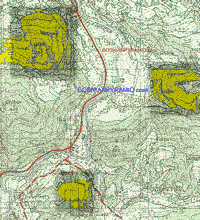
Precise satellite filming by NASA Landsat, Radarsat, Hyperion and Ikonos, for example, confirmed the existence of five elevations in the Bosnian Valley of Pyramids. The elevations show significant characteristics of “geophysical anomalies” (i.e. two or more sides have three straight angles). These ‘elevations’ are now known as the Pyramids of the Sun, Moon, Dragon, Temple of Earth, and Love.
Satellite radar (Radarsat) penetrating the soil over the Pyramid of the Sun also showed the existence of straight passages inside the Pyramid of the Sun which cross at angles of 90 degrees.
The international verification of these results is ongoing. In the meantime, at the end of June a team of Egyptian experts confirmed that “Visocica and Plesevica are created by humans” and their findings have been repeated by other international experts.
Barakat: ‘This is man-made pyramid’ 24 June 2006
The two Egyptian scientists working at the Bosnian pyramids - geologist Barakat and archeologist Lamia El Hadidi – have made some of their findings public prior to completing their work at the site. They conclude that there are ancient man-made structures in the Visocica Hill region.
When he first arrived in Bosnia, geologist Barakat said that Visocica Hill was probably ‘some kind of primitive pyramid’. After more than a month working at the site, his opinion remains unchanged.
Barakat said, “For me, as a scientist and geologist, there’s still no doubt that this is man-made. I think that humans cut, polished, reshaped and formed stone blocks {that form the pyramid), bringing them here and adding them to the existing hill in order to give the shape of a pyramid to the hill.”
Archaeologist El Hadidi added that a large archaeological site has been found on the so-called Pyramid of the Moon, near to the Bosnian Pyramid of the Sun. She said they were unable, at this stage, to date the site, saying that further research is needed. However, she confirmed earlier conclusions that this site also represents a pyramid. “It is really impossible that nature creates shapes like this. Maybe one, but not three or four sides of the hill as we have here. There is still a lot of work to be done here, if we want to unveil all the secrets of this valley.”
Scepticism about the existence of the pyramids remains within parts of the scientific community. This may be partly because the site in Bosnia does not represent our traditional image of pyramids - as in Egypt - but a different kind of structure where stones have been placed around an existing hill to form the shape of a pyramid.
A complex of manmade tunnels has also been found at the site. It has been suggested that the tunnels may connect the three pyramids. In one of the tunnels, a large polished monolith has been found with unknown carved inscriptions including arrows and a shape similar to our letter ‘E’.
If you can't see video clip (click here)
This wek at Visoko
Dr. Robert M. Schoch (USA) will visit Visoko site . Schoch who is a geologist known for his research on the Great Sphinx, as well as for his studies of the underwater structure off the coast of Yonaguni Island, Japan, and other ancient sites and studies. He is currently a tenured faculty member at Boston University's College of General Studies where he has taught since 1984. Dr. Schoch completed his graduate work at Yale University, earning a Ph.D. (1983) in geology and geophysics.
Latest discovery proves pyramid theory
18 June 2006
A press conference held earlier today (Sunday) at the Bosnian Pyramid of the Moon puts “beyond doubt” the existence of a pyramid at the site, says the Archeological Park: Bosnian Pyramid of the Sun (APBPS).
The Pljesevica Hill was previously named the Bosnian Pyramid of the Moon by the APBPS Foundation. Experts from the Foundation have now revealed the discovery of a vertical wall that forms part of the Pyramid of The Moon.
Lamia el-Hadidi (Conservation Specialist, Egypt) assumes that the wall forms part of a tomb belonging to the pyramid. She pointed out that the wall is clearly manmade, comprising blocks that have been cut by man, refined and used to build this vertical wall.
Prof.Dr.Ric.Geol. Dario Andretta, chairman of the Humanitarian University for the Multidisciplinary International Culture (Rome), announced that this evidence puts beyond doubt the existence of a true pyramid at this site.
Experts from APBPS expect to have further announcements about the nature of the wall that has been discovered in the next two to three days. Excavations will now continue to take place to the left, right and above the wall. The team has also discovered steps which they say probably lead into the tomb.
Andretta has also announced that more experts from across Italy will be coming to join Bosnians on the site to be part of largest current international archeological project.
It is said that the discovery of the entrance at the Bosnian Pyramid of the Moon proves beyond doubt that this is a true pyramid.
Foundation seeks international support
14 June 2006
Massive manmade blocks found at the Bosnian Pyramid of the Moon and Bosnian Pyramid of the Sun excavation sites back claims that these are pyramids, says the Foundation of the Archaelogical Park; Bosnian Pyramid of the Sun. Yet the belief – or not – in the existence of the pyramids is dividing communities within Bosnia.
Surprisingly, perhaps, to outsiders, Bosnia’s own archaeological community remains opposed to the excavation of the pyramidal structures, claiming it will damage the ruins of a Medieval town on the top of the Pyramid of the Sun.
The Foundation responds that the medieval ruins are protected by an ‘exclusion zone’; no excavations are taking place within this area.
Quote: “Official State people have been on the site to check all our work and they confirmed that all the work is being done 200 metres away from the protected zone.”
Supporters of the pyramid theory also point out, somewhat wryly, that it was these very experts who should have protected the Medieval ruins in previous years; very little now remains of these old structures, something for which the excavations are now taking the blame.
Even English experts have been drawn into the wrangle. Prof Anthony Harding, president of European Archaeological Association wrote to The Times to say that the project at the Bosnian Pyramids was destroying the town at the top of the site – after a 15 minute trip bypassing the pyramid.
Despite the divisions, the excavations go on and the site is raising considerable interest from international experts, including experts from Egypt who are currently on site.
The level of interest is such that the Foundation has put out an urgent request for additional administrative and funding support for its work.
Prof.Dr.Ric.Geol. Dario Andretta link
Lamia el-Hadidi, Conservation Specialist link


Top of Page